
I’ve been thinking about this a lot lately after coming across a cluster of startups trying to upend market research using AI. Within the span of the last couple months, companies like Simile and Aaru have raised hundreds of millions of dollars chasing the same idea: replace traditional consumer research with AI-generated simulations. It caught my attention because it cuts right to a problem I’ve run into throughout my career in BD. One of the harder parts of business development and partnerships is figuring out how customers will respond to something before you’ve built it. Will they actually want this product? Will they adopt this feature? Will the new product/service cannibalize other areas of your business? These questions typically sit at the center of most BD decisions and yet we often have to answer them with surprisingly limited information using more “gut” instinct.
Tag: Partnerships
Update (March 2026)
As I alluded to in my post below from just two months ago, ChatGPT has scaled back their Instant Checkout product given a less than ideal customer experience and has opted for fewer more end-to-end integrations which was my recommendation. Walmart, for example, saw ChatGPT checkout convert 3x worse than Walmart’s own website.
_______
A bit of a longer post today given all the platform deals that have been taking place (Waymo partnering with Uber, ChatGPT rolling out services from booking hotels to buying physical items, etc), that I wanted to share my experience having done these types of deals along with key learnings.
I’ve been reading daily, both articles and through posts on LinkedIn, about OpenAI enabling new services via ChatGPT, everything from being able to get an Uber, to book a reservation at a restaurant to ordering groceries via Instacart. None of this is surprising since when OpenAI launched ChatGPT plugins (and later custom GPT apps), they weren’t shy about the ambition. Sam Altman effectively hinted at an “App Store for AI” being a future where you could order a rideshare, book a table, or grocery shop all through ChatGPT’s interface, without ever touching a separate app. The idea, in theory, would be an AI App Store that would unify countless services behind one conversational interface (ChatGPT), sparing us the jumble of apps on our phones. In practice, however, the execution to-date feels like its fallen short ultimately because OpenAI’s strategy emphasized breadth over depth, integrating dozens of partners quickly, at the expense of building truly seamless experiences for the end user. The result is mostly a collection of clunky, half-baked plugin interactions that feel more akin to affiliate marketing than a truly end-to-end integration.
Every new platform faces a classic dilemma whether to go broad fast or go deep on a few core use cases. Google went deep for example with products like Google Maps enabling only affiliate type links for 3rd party partners. OpenAI clearly chose to go broad, opening a wide range of ChatGPT plugins in months. Unfortunately, many of these integrations lack the tight product coupling needed to make them useful. The user experience feels disjointed. This isn’t a new problem. I’ve seen the pitfalls of “breadth over depth” play out before, across various partnership bets in tech. In fact, five firsthand partnership anecdotes from my career illustrate why shallow integrations underwhelm, and why deep, end-to-end integrations are what truly drives the best experience for the customer. Each story, from ride-hailing to meal kits, carries a lesson that OpenAI (or other platforms) would do well to heed.
AI is moving fast, but the business models behind it are even harder to decode. I’ve been spending time mapping out who the key customers are and how money flows through the system. Foundational providers (OpenAI, Anthropic, etc), wrappers (Harvey, Jasper, etc) — each plays a different role in the value chain, and investors and operators alike are still figuring out how to navigate the commercial landscape.
I’ve built and scaled growth models at companies like Newell Brands, Casper, Blue Apron, and Lime, and today I advise startups, investors, and corporates on how to navigate this shifting landscape. To cut through the noise, I created this AI Business Model Guide — a simple framework to understand where opportunities lie and where risks emerge.
If you’re building in AI or exploring partnerships, this guide is a starting point. The presentation is embedded below.
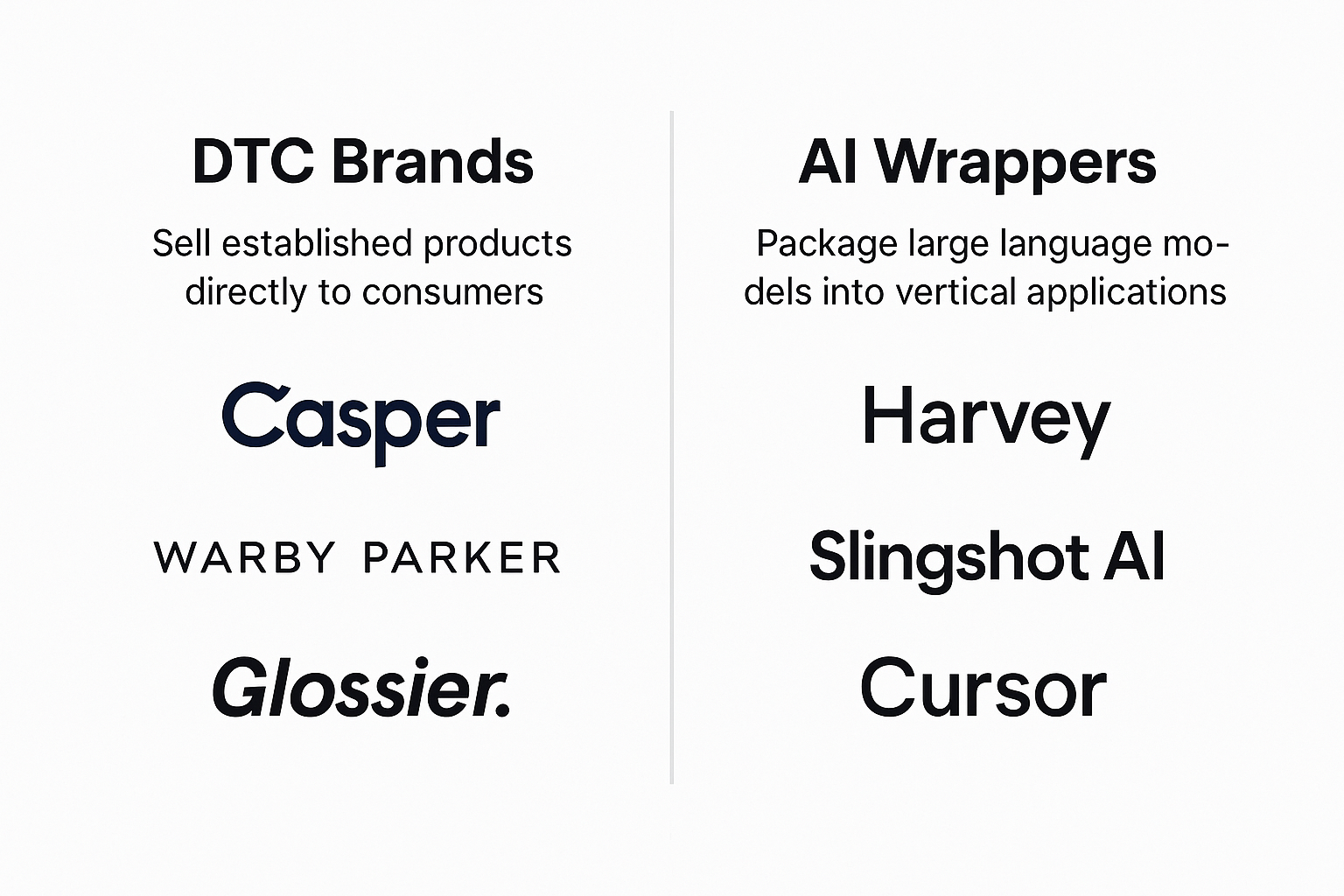
Over the last year, niche AI startups have exploded onto the scene. Companies like Slingshot (mental health), Harvey (legal), and Jasper (marketing), Cursor (code editor) are racing to stake out territory on top of large language models like ChatGPT and Gemini. At first glance, they feel innovative and differentiated. But if you squint, they look a lot like the early wave of direct-to-consumer (DTC) brands — Casper, Warby Parker, Glossier, Harry’s and Peloton — that disrupted incumbents not by reinventing the product, but by reshaping the story, distribution, and consumer experience.
I saw this firsthand at Casper. We weren’t reinventing the mattress — foam was foam — but we were reinventing the consumer experience and telling a story incumbents weren’t telling. We addressed a lot of the pain points in the legacy purchase experience (returns, trial, etc) with novel solutions.
The analogy here is hard to ignore.
The big management consulting firms will have to adapt quickly to AI. The days of paying half a million dollars for a strategy deck are over. By way of example, I was curious, what is next for the food delivery sector (e.g. UberEats, DoorDash, etc) so I put together a prompt and leveraged ChatGPT.
One of the most difficult aspects of doing partnerships or business development regardless of industry or sector is clearly understanding why two parties should get “married.” In my experience building numerous JV’s/partnerships, one theme continues to resonate, and that is how do you construct a winning partnership where each side feels as if they have gotten equitable value. Oftentimes, initial discussions tend to be more tactical or acutely focused on a very specific asset that one side seeks access to, when the focus should be framing the outcome from inception. This entails being able to articulate clearly the ‘gives’ and ‘gets’ of a deal and not jumping right into the weeds. Jeff Bezos has said, at Amazon, before any work is done on a new partnership, the press release is written. This accomplishes a couple key things.
I’ve written before about the appeal of partnerships and Peloton’s recent deal with United Healthcare (UHC) is another example of why this can be extremely powerful. Beginning in September, UHC customers on employer sponsored plans will get complimentary access to Peloton’s digital subscription for one year. Afterwards, customers can continue and pay Peloton directly or simply let the subscription lapse. We’ve seen trial deals on entertainment subscription products now for a few years (think Netflix and TMobile, Verizon and Disney+, Hulu & Spotify, etc), with more likely in the pipeline. All of these services struggle with high customer acquisition costs and partnerships are an extremely effective way to grow.
A VC once told me that 50% of some of their portfolio companies’ growth is coming through partnerships. I wasn’t surprised, but I found this quite interesting, because successful structure and execution seems to be the achilles heel of many organizations.
Through the marketing lens, there’s no shortage of content and advice on how to grow your startup. The thing is, most startups look at marketing as a cost center (which it usually is) but there is white space here that is more efficient than marketing and that is through partnerships. Now, I know “partnerships” is a broad term, but let’s try and narrow it down by focusing purely on revenue generating initiatives. In previous roles at Casper and Newell Brands, I oversaw numerous innovative partnerships and here are some lessons I learned as well as some thoughts on why this space continues to be undervalued.
Startups usually focus on pain points that consumers have found with large bureaucratic companies. The old guard typically misses the signs when an insurgent brand comes on their turf, or they simply believe it’s not going to be a threat. Meanwhile this gives the entrepreneur time to build up a small loyal group of customers. As a result of corporate venture capital teams, and an increased interest in following startup land closely, corporations are no longer sitting back idle while startups take share.